Urban beekeeping in Edmonton is bringing communities together to improve food security.

Cole Buhler – Edmonton, Alta. BCSC 327.

Amelia Altmiks, a 26-year-old MacEwan University student, is the owner and operator of The Hive Urban Community Agriculture. Altmiks’s company is a beehive management service that holds workshops in urban communities to foster food security awareness and education.

“Supporting our bees is us supporting the rest of our communities,” Altmiks said during the Food Medicine workshop in the Alberta Avenue Community League on February 29th.

Amelia Altmiks – the owner and operator of The Hive Urban Community Agriculture

The workshop is designed to teach attendees about honey bee food systems, the fair trade certification system, how to eat locally better, the work local food organizations accomplish, and how to grow native plants that will accommodate pollinators within Alberta.

Altmiks also demonstrated how local herbs can be used to infuse honey with diverse flavours. Attendees paid a small five-dollar fee to mix honey with herbs such as lavender and sage. Guests got to take their infused honey home with them, courtesy of the honeybees of the MacEwan University Office of Sustainability’s urban beekeeping program.

Altmiks has been a part of the MacEwan urban beekeeping program for two years and helps to maintain the honeybees on top of building five.

The urban community is important to Altmiks and represents a diverse group of people who can be at risk for adverse food security. “I grew up on 55th street, just up the avenue, and our closest grocery store was a 20-minute walk…and we didn’t have a vehicle,” Altmiks said, “so things like that can really change the quality of food that you’re getting.” More community beehives go a long way in creating local, diverse food sources.

Kaitlyn Dryden, a MacEwan graduate and yoga instructor, plans on planting flowers and building a bee hotel on her apartment balcony to attract pollinators but is concerned about Boardwalk’s stance on the matter. “I’d like to, but it’s Boardwalk and you never know with apartment boards,” Dryden said.

Kaitlyn Dryden, attending the Food Medicine workshop – holding MacEwan honey.

Altmiks spoke about local landscaping companies like Spruce Permaculture who specialize in creating community gardens and transforming local lawns and backyards into “food forests and native meadows.” These native plants and flowers help to attract honeybees and other pollinators and create biodiversity within Alberta. But, as with most yard renovation, “it really depends on your neighbours…if they’re going to complain about your garden not looking as manicured,” Altmiks said.

Altmiks also spoke about local NGOs such as Operation Fruit Rescue Edmonton, which is “a not-for-profit organization that will mobilize volunteers to harvest, process, and preserve donated local fruit.” Fruit pickers pay a 25$ fee to be added to OFRE’s list of volunteers and will be contacted when local houses with fruit bearing trees and plants are added to the program.

Volunteers bring back as much fruit as they can carry to be divided into quarters. Pickers get to keep 1/4th of the fruit, while another 1/4th goes to Edmonton’s Food Bank or other charitable organizations. The homeowner gets to keep 1/4th of the fruit, and the remaining 1/4th goes back to OFRE for processing – for events such as the annual cider party for members.

Altmiks finished the workshop by mentioning local, River Valley Food Forest creator Dustin Bajer and his work with honeybees. Attendees were encouraged to take his beekeeping courses for their own backyard hives.
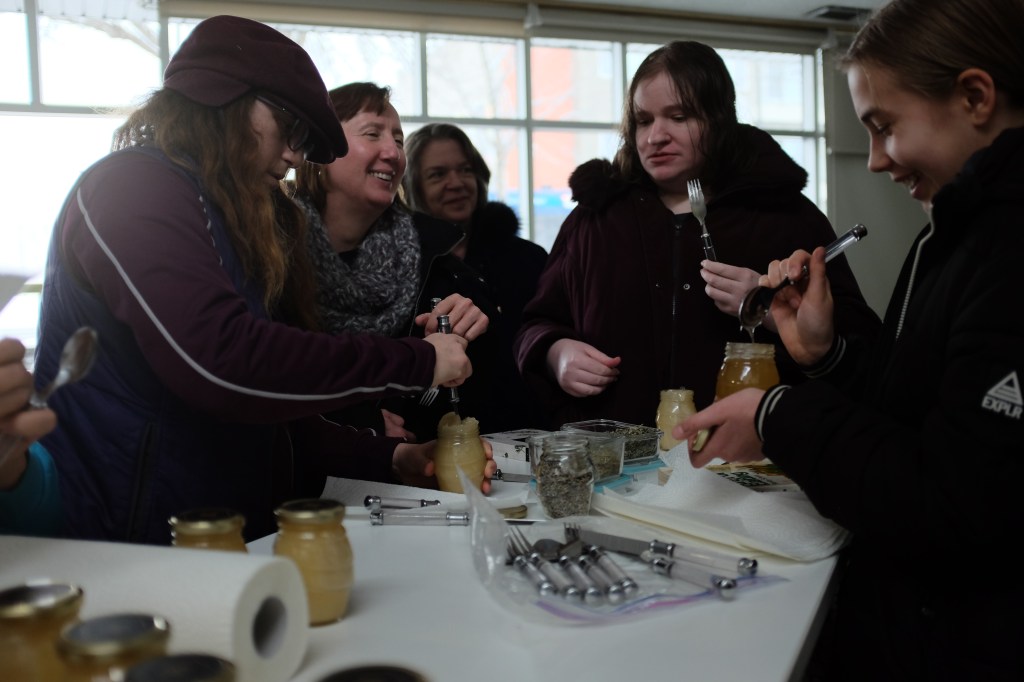

Altmiks has been beekeeping for four years and is currently in the second year of the Bachelor of Arts program with a major in philosophy at MacEwan University. The Hive Urban Community Agriculture’s workshops are funded by the MacEwan University Student Community Engagement Grant.

“We Need a New Generation of Journalists” – Professor Johan Lidberg and Fighting the Democratic Flu.

Cole Buhler – Edmonton, Alta. BCSC 327.

Professor Johan Lidberg of Monash University in Melbourne, Australia, held a keynote speech on the future of global surveillance and security within journalism today at Grant MacEwan University.

Lidberg, author of In the Name of Security Secrecy, Surveillance and Journalism, discussed the Australian sport of “whistleblower hunting,” how climate change is more important than the spectre of terrorism, and how “we need a new generation of journalists.”

“It’s come to the point where I’ve fought a democratic flu,” Lidberg began, “how far are we prepared to go in the name of security?”

Lidberg’s main concern is that Australia lacks a bill of rights protecting journalists and their sources. This has led to “whistleblower hunting,” or what Lidberg refers to as an “Australian sport.”

Australia has amended over 80 national security laws since 2001. These expanded laws have enabled police raids in the search for whistleblowers.

Whistleblowers in Australia don’t have the same protection as they do in Canada and can face 2 to 3 years in prison. When asked about the state of Australian press freedom, Lidberg said that “it is not surprising…if we look at the worst side, we find Australia and the U.K.”

Canada, meanwhile, may have a charter of rights and freedoms but journalists can still face jail time for refusing to give up their sources. J-Source writes that the federal government can request the identity of a source if “the public interest in the administration of justice outweighs the public interest in preserving the confidentiality of the journalistic source.”

Dr. Brian Gorman, an Associate Professor at MacEwan University, said in an interview that journalists facing jail time should never disclose their sources because people who don’t feel safe won’t give information. “There needs to be some kind of protection,” Gorman said.

Security laws in Australia, on the surface, were expanded to combat the growing threat of extremism and terrorism, but for Lidberg, “the war on terror has no single identifiable enemy…a lot of the real and perceived threats come from within nation states, as well as from outside.”

With the real threat coming from within, Lidberg asks the question: “Is climate change not a greater threat to us than terrorism?”

World Wildlife Fund Australia writes that bushfires in Australia have burned over 2700 homes and killed 33 people as well as an estimated 1.25 billion animals from 2019 to 2020. Lidberg said that this catastrophic event could lead to the extinction of several species.

Lidberg also mentioned the destruction of the Great Barrier Reef. National Geographic writes that “half of the Great Barrier Reef has been bleached to death since 2016.”

Lidberg said that Australians could become the world’s first climate refugees.

But no one is writing about it.

In fact, for Lidberg, there is a lack of coverage on climate change throughout Australia. Lidberg mentions that News Corp, the Murdoc owned media giant, is notorious for their disinterest in climate change.

“News Corp has polluted the public sphere,” Lidberg said.

Lidberg has seen the destruction of the bushfires up close and personal. His family escaped the fires during a camping trip.

“It is actually like being in a war zone,” Lidberg said.

Lidberg’s solution to fight this democratic flu is a new generation of young, transparent journalists who engage with their communities to encourage and foster trust during a time when political strongmen dominate the media landscape with authoritarian rhetoric.

“If you have support from the people that is the best way to influence the government,” Lidberg said.

“We Need a New Generation of Journalists” – Professor Johan Lidberg and Fighting the Democratic Flu. (Quick Hit)

Professor Johan Lidberg of Monash University in Melbourne, Australia, held a keynote speech on the future of global surveillance and security within journalism today at Grant MacEwan University.

Lidberg covered the worrying future of journalism within Australia and the attacks on press freedom and rights by government officials.

Topics covered included the prosecution of Australian journalists, “whistleblower hunting,” and journalism centered on terrorism versus climate change.

Australia doesn’t have a charter of rights and freedoms that protects journalists from being “hunted” and they have faced unfair prosecution over refusing to disclose sources and information.

Lidberg’s solution to the problem facing press freedom within Australia is that we need a “new generation of journalists” who are transparent and engage with local audiences to encourage and foster trust during our current political climate.

Lidberg is hopeful that Australia can move towards a Media Freedom Act that will enable journalists to combat the dissolution of press freedom by asking “how far are we prepared to go in the name of security?”

Design a site like this with WordPress.com
Get started